
Exchange rates influence far more than the price of a vacation abroad. They affect the cost of imported goods, company profits, international investments, fuel prices, government borrowing, and even household budgets.
For investors and traders, understanding currency movements is also an important part of market research. Before accessing currency markets, people often compare trading conditions, fees, regulations, and available platforms through resources such as IamForexTrader. However, choosing how to access the market is only one part of the process. It is equally important to understand why currencies rise and fall in the first place.
There is rarely a single explanation for a currency movement. Exchange rates usually react to a combination of economic data, central bank decisions, political developments, global demand, and investor expectations.
Below are seven of the most important factors affecting exchange rates.
1. Interest Rates
Interest rates are among the most closely watched drivers of currency values.
Central banks use interest rates to influence inflation, economic activity, borrowing, and spending. When a central bank raises rates, savings and fixed-income investments denominated in that currency may become more attractive to international investors.
This can increase demand for the currency.
For example, suppose one country offers government bonds with a significantly higher yield than another. International investors may exchange their money into the higher-yielding currency to purchase those bonds. As demand rises, the currency may strengthen.
The opposite can happen when interest rates are cut. Lower rates can make a currency less attractive, particularly when investors can earn better returns elsewhere.
However, the relationship is not always straightforward. Markets often react before a central bank makes its decision. If investors already expect an interest rate increase, the currency may rise weeks or months in advance.
By the time the official announcement arrives, much of the expected movement may already be reflected in the price.
Currency markets do not react only to what central banks do. They react to the difference between what happens and what investors expected to happen.
This is why central bank statements, speeches, meeting minutes, and economic projections can be just as influential as the rate decision itself.
2. Inflation
Inflation measures how quickly prices for goods and services are increasing.
Moderate inflation is common in a growing economy. However, persistently high inflation can reduce the purchasing power of a currency. If prices rise faster in one country than in its trading partners, that country’s exports may become more expensive and less competitive.
Over time, this can weaken demand for the currency.
Inflation also affects exchange rates indirectly through central bank policy. When inflation rises above the central bank’s target, policymakers may respond by increasing interest rates. Higher rates can support the currency, even though the original inflation problem may have placed downward pressure on it.
This creates a complicated relationship:
- High inflation can reduce purchasing power.
- High inflation may lead to higher interest rates.
- Higher interest rates can attract foreign capital.
- Investors must decide which effect is more important.
The market reaction often depends on whether inflation is temporary or persistent. A short-lived increase caused by energy prices may be viewed differently from broad inflation affecting wages, housing, services, and consumer goods.
3. Economic Growth
Currencies are often influenced by expectations about economic growth.
A strong economy may attract foreign investment because companies are expanding, consumers are spending, and businesses may generate higher profits. International investors purchasing local shares, property, or bonds typically need the country’s currency to complete those transactions.
This can create additional demand.
Common economic indicators used to evaluate growth include:
- Gross domestic product;
- Employment data;
- Retail sales;
- Industrial production;
- Business confidence;
- Consumer confidence;
- Manufacturing and services activity.
Strong data can support a currency, while weaker-than-expected data may push it lower.
Yet faster growth does not always guarantee a stronger exchange rate. If economic expansion is driven by excessive debt or produces rapidly rising inflation, investors may become concerned about long-term stability.
The quality and sustainability of growth matter as much as the headline number.
4. Trade Balances
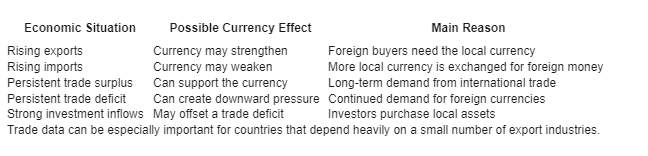
The trade balance measures the difference between a country’s exports and imports.
A country has a trade surplus when it exports more goods and services than it imports. It has a trade deficit when imports exceed exports.
When foreign buyers purchase exports, they may need to acquire the exporter’s currency. Consistent demand for a country’s products can therefore support its exchange rate.
A country that imports significantly more than it exports may experience the opposite effect. Domestic businesses and consumers must exchange their currency for foreign currencies to pay overseas suppliers.
However, trade balances should not be viewed in isolation. Some countries maintain large trade deficits while still attracting substantial foreign investment. Capital flowing into financial markets can offset money leaving the country through trade.
How Trade Flows Can Affect a Currency
5. Commodity Prices
Commodity prices can have a major influence on currencies linked to oil, natural gas, metals, or agricultural exports.
When the price of a country’s main export rises, its businesses may receive more foreign revenue. This can improve the trade balance, increase tax income, and strengthen economic growth.
As a result, demand for the country’s currency may increase.
For example, an oil-exporting economy may benefit when global energy prices rise. A country that imports most of its energy may face higher costs and a weaker trade position under the same conditions.
Commodity-linked currencies may respond to changes in:
- Crude oil prices;
- Natural gas prices;
- Gold and metal prices;
- Agricultural markets;
- Global industrial demand;
- Supply disruptions.
The effect depends on the structure of the economy. A higher oil price may support one currency while placing pressure on another.
Commodity prices can also react quickly to geopolitical events, extreme weather, sanctions, transportation disruptions, and production decisions.
6. Political Stability and Government Policy
Currency markets generally prefer predictable economic and political conditions.
Political uncertainty can make investors less willing to hold assets in a country. Elections, constitutional disputes, sudden policy changes, civil unrest, sanctions, and international conflicts can all increase perceived risk.
When uncertainty rises, investors may move money into assets they consider safer or more liquid.
Government policy can also influence currency values through:
- Tax decisions;
- Public spending;
- Budget deficits;
- Borrowing levels;
- Business regulation;
- Trade restrictions;
- Capital controls.
Large government deficits do not automatically weaken a currency. Investors also consider whether the country can finance its obligations, whether the economy is growing, and whether institutions remain credible.
Confidence is essential. If investors begin to doubt a government’s ability to manage its finances or maintain stable institutions, the currency may come under pressure.
Political events can produce sharp short-term movements, but the longer-term effect depends on whether they change economic fundamentals.
7. Market Expectations and Investor Sentiment
Exchange rates are forward-looking.
Currencies often move because investors expect something to happen, not because it has already happened.
Market participants constantly form opinions about future:
- Interest rate changes;
- Inflation trends;
- Elections;
- Economic growth;
- Recessions;
- Trade policies;
- Geopolitical risks;
- Corporate and investment flows.
Suppose investors believe a central bank will begin raising rates in six months. The currency may strengthen immediately, long before the first increase.
If later data makes that outcome less likely, the currency may reverse direction.
Investor sentiment can also create movements that appear disconnected from local economic data. During periods of global uncertainty, traders and institutions may reduce exposure to riskier markets and move funds into currencies associated with liquidity or financial stability.
This behavior is often described as a “risk-off” environment.
During more optimistic periods, capital may flow toward faster-growing economies and higher-yielding assets. This is commonly called a “risk-on” environment.
How the Main Factors Interact
The factors affecting exchange rates rarely operate independently.
A stronger economy may increase inflation. Higher inflation may encourage the central bank to raise interest rates. Higher rates may attract investment, but they can also slow consumer spending and business activity.
Similarly, rising commodity prices may improve the trade balance of an exporting country while increasing inflation at home.
A useful way to understand currency movements is to examine the chain of consequences rather than a single data point.
Example of an Economic Chain Reaction
Imagine that energy prices rise sharply:
- An oil-exporting country earns more from international sales.
- Its trade balance improves.
- Government revenue increases.
- Economic growth expectations rise.
- Inflation may also accelerate.
- The central bank considers raising interest rates.
- Investors reassess the value of the currency.
The final exchange-rate movement will depend on which parts of this chain investors consider most important.
Why Currencies Sometimes Move Against the News
A common source of confusion is seeing a currency fall after apparently positive news.
This often happens because the market had expected even better results.
For example, employment may rise, but if investors expected a much larger increase, the data can still be interpreted as disappointing. A central bank may raise interest rates, but the currency may fall if policymakers indicate that no further increases are likely.
Currency markets compare reality with expectations.
This means that three questions matter:
- What happened?
- What did the market expect?
- What does the new information suggest about the future?
The third question is often the most important.
Can Governments Control Exchange Rates?
Governments and central banks can influence exchange rates, but their level of control varies.
Some currencies float freely, meaning their values are largely determined by supply and demand. Others are managed within a range or linked to another currency.
Authorities may attempt to influence exchange rates by:
- Buying or selling currencies;
- Changing interest rates;
- Introducing capital controls;
- Adjusting foreign exchange reserves;
- Communicating future policy intentions;
- Coordinating action with other central banks.
Direct intervention can cause immediate market movements. However, maintaining an exchange rate that conflicts with economic fundamentals can be expensive.
A central bank defending its currency may need to spend foreign exchange reserves. If investors believe those reserves are insufficient, pressure on the currency may continue.
What Exchange Rate Changes Mean for Businesses and Consumers
Currency movements affect everyday economic activity.
A weaker domestic currency can make imported products more expensive. This may raise the cost of fuel, electronics, machinery, medicine, and food.
At the same time, exporters may benefit because their products become cheaper for foreign customers.
A stronger currency can reduce import costs but make exports less competitive.
For businesses, exchange-rate changes can affect:
- Revenue from international customers;
- Costs paid to overseas suppliers;
- Profit margins;
- Loan repayments;
- Expansion decisions;
- Product pricing.
Companies with international operations often use financial instruments or contractual arrangements to reduce their exposure to currency fluctuations.
Consumers may notice exchange-rate effects through higher prices, travel expenses, foreign subscriptions, or the cost of sending money abroad.
A Practical Framework for Following Currency Markets
No one can predict exchange rates consistently, but a structured approach can make currency news easier to understand.
Start by following:
- Central bank decisions and speeches;
- Inflation and employment reports;
- Economic growth indicators;
- Trade balance data;
- Political and geopolitical developments;
- Major commodity price movements;
- Changes in market expectations.
Avoid drawing conclusions from one headline. A strong employment report may support a currency, but its effect may be limited if inflation is falling and interest rate cuts are still expected.
Context matters more than any single statistic.
Final Thoughts
The main factors affecting exchange rates include interest rates, inflation, economic growth, trade flows, commodity prices, political stability, and investor expectations.
These forces are connected, and their influence can change over time. An interest rate increase may strengthen a currency in one situation but have little effect in another if investors had already anticipated it.
Understanding exchange rates therefore requires more than monitoring isolated news events. It involves examining how economic conditions, government policy, and market expectations interact.
Currencies do not move simply because news is good or bad. They move because new information changes how investors view the future.